Gichin Funakoshi’s 20 Guiding Principles of Karate-Do (Nijū Kun) Explained

Master Gichin Funakoshi, the founder of Shotokan karate, laid out the Twenty Precepts of Karate (Niju kun), which are there as a guide for all karateka to follow and adhere to. These principles form the foundations of Shotokan karate. These twenty principles were based heavily on Bushido and Zen.

The principles allude to notions of respect, humility, compassion, patience, awareness and both an inward and outward calmness.

free shotokan karate ebook

Shotokan Nijū kun (Shotokan 20 Principles)

1. Karate-do begins with Rei and ends with Rei. (Rei means courtesy / respect)

2. There is no first strike in karate.

3. Karate is an aid to justice.

4. First know yourself then know others.

5. Spirit comes first, technique second.

6. Always be ready to set your mind free.

7. Misfortune comes out of laziness accidents arise from negligence.

8. Do not think that karate training is only in the dojo.

9. It will take your entire life to learn karate, there is no limit.

10. Put Karate into your everyday life any you will find its subtle secrets.gichin funakoshi quote
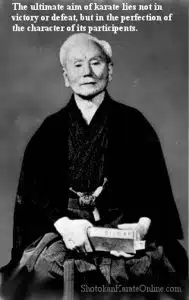
11. Karate is like boiling water, without heat, it returns to its tepid state.

12. Do not think that you have to win – rather that you do not have to lose.

13. Make adjustments according to your opponent.

14. The outcome of the battle depends on how you handle weakness and strength.

15. Think of hands and feet as swords.

16. When you leave home, there are a million enemies waiting for you.

17. Beginners must master low stances and posture, natural body positions are for advanced students.

18. Practice prescribed sets of techniques exactly; actual combat is another matter.

19. Do not forget the employment of withdrawal of power, the extension or contraction of the body, the swift or leisurely application of technique.

20. Be constantly mindful, diligent, and resourceful, in your pursuit of karatedo (the Way of karate).

Shotokan Niju Kun

shotokan niju kun

FAQ: Gichin Funakoshi's 20 Guiding Principles (Nijū Kun)

What are the 20 Guiding Principles of Karatedo? 

They are a list of 20 moral and philosophical maxims, known as the Nijū Kun (Twenty Precepts of Karate), which serve as a foundational guide for all students of karate (karateka). 

1. Karate-do begins with Rei and ends with Rei. (Rei means courtesy / respect)

2. There is no first strike in karate.

3. Karate is an aid to justice.

4. First know yourself then know others.

5. Spirit comes first, technique second.

6. Always be ready to set your mind free.

7. Misfortune comes out of laziness accidents arise from negligence.

8. Do not think that karate training is only in the dojo.

9. It will take your entire life to learn karate, there is no limit.

10. Put Karate into your everyday life any you will find its subtle secrets.

11. Karate is like boiling water, without heat, it returns to its tepid state.

12. Do not think that you have to win - rather that you do not have to lose.

13. Make adjustments according to your opponent.

14. The outcome of the battle depends on how you handle weakness and strength.

15. Think of hands and feet as swords.

16. When you leave home, there are a million enemies waiting for you.

17. Beginners must master low stances and posture, natural body positions are for advanced students.

18. Practice prescribed sets of techniques exactly; actual combat is another matter.

19. Do not forget the employment of withdrawal of power, the extension or contraction of the body, the swift or leisurely application of technique.

20. Be constantly mindful, diligent, and resourceful, in your pursuit of karatedo (the Way of karate).

Who created these principles?

The Nijū Kun were created by Master Gichin Funakoshi (1868–1957), the founder of the Shotokan school of karate.

What two philosophical concepts are the principles heavily based on?

The 20 principles are heavily based on the philosophies of Bushido (the Way of the Warrior) and Zen.

What are the key moral themes emphasized in the Nijū Kun? 

The principles allude to notions of respect, humility, compassion, patience, awareness, and cultivating both an inward and outward calmness in everyday life.

What is the meaning of the first principle: "Karate-do begins with Rei and ends with Rei"?

Rei means courtesy or respect. This principle establishes that respect is the essential attitude that must govern the entire practice of karate, signifying that the Way of Karate is one of character development and courtesy.

How does the Nijū Kun relate to fighting? 

The philosophy encourages a non-aggressive stance, embodied by the principle "There is no first strike in karate." It stresses that karate is an "aid to justice," meant for defense and morality, not for initiating violence. “Karate ni sente nashi” (There is no first attack in karate)

Do the principles apply only to training in the dojo?

No. Principles 8 and 10 make it clear that the teaching is for life: "Do not think that karate training is only in the dojo," and "Put Karate into your everyday life any you will find its subtle secrets."

What is more important: technique or mental attitude? 

According to Principle 5, "Spirit comes first, technique second." This means that the student's mindset, resolve, and moral character are more vital than mere physical skill.

How long does it take to truly learn Karatedo?

Principle 9 states, "It will take your entire life to learn karate, there is no limit." Karatedo (The Way of Karate) is viewed as a lifelong journey of self-improvement and discovery.

What advice is given about self-knowledge and opponents?

Principle 4 advises "First know yourself then know others." This means understanding your own strengths and weaknesses is the necessary first step before attempting to understand and adapt to an opponent.

What is the warning given about diligence and focus?

Principle 7 offers a serious caution: "Misfortune comes out of laziness accidents arise from negligence." This stresses the need for constant effort and mindfulness to avoid unnecessary failures.

What is the guidance for beginners regarding body position?

Principle 17 states: "Beginners must master low stances and posture, natural body positions are for advanced students." This instructs beginners to focus on building a strong foundation by practicing demanding, formalized stances before transitioning to more relaxed, efficient movements.

How does the Nijū Kun describe the state of constant training?

Principle 11 states: "Karate is like boiling water, without heat, it returns to its tepid state." This means constant, sustained effort is necessary to prevent skills and conditioning from fading away.


Posted on Google Google
Emilio Taranto profile picture
Emilio Taranto
Google star 1Google star 2Google star 3Google star 4Google star 5Trustindex verifies that the original source of the review is Google.
Shotokan Karate Online has excellent lessons. The explanations are clear, the videos detailed, and the techniques well broken down. Sensei Huckle’s guidance makes it easy to follow and really helps improve both skill and understanding. Highly recommended for anyone wanting to get better at karate.
Posted on Google Google
Kevin profile picture
Kevin
Google star 1Google star 2Google star 3Google star 4Google star 5Trustindex verifies that the original source of the review is Google.
Shotokan Karate Online is an invaluable resource for martial artists around the world looking to further their knowledge in an amazing art form. The curriculum is easy to follow, the practice videos are of a very high quality, the feedback is personal, informative and supportive. And, above all the journey through the techniques, skills, philosophy and rank belts has been nothing but incredible. Thanks SKO for helping me be a better martial artist. You guys ROCK!!!
Posted on Google Google
Russ Kinnell profile picture
Russ Kinnell
Google star 1Google star 2Google star 3Google star 4Google star 5Trustindex verifies that the original source of the review is Google.
Shotokan Karate Online has a HUGE video library of kata, waza, etc. The videos are well organized and everything is described in meticulous detail. It's great for learning or for supplementing you training.
Posted on Google Google
Robert Gale profile picture
Robert Gale
Google star 1Google star 2Google star 3Google star 4Google star 5Trustindex verifies that the original source of the review is Google.
I have been training and teaching in shotokan karate over a period of 37 years. Since signing up for SKO and ENSO, I have found the the supplementary training and advice provided has greatly enhanced my karate knowledge and capability. In particular, the online live sessions, with extensive technical detail and knowledge of Okinawan kata has been invaluable. All serious karateka would benefit from exploring this incomparable source.
Posted on Google Google
Marious Ranasinghe profile picture
Marious Ranasinghe
Google star 1Google star 2Google star 3Google star 4Google star 5Trustindex verifies that the original source of the review is Google.
Actually to be honest i have completed two grading from sko dojo and I have to say this sensei huckle is doing his best to teach his online student and the techn̈iques he teaches is perfect for self deffence as I have a karate experience little bit I know this class is thè best to whom that looking to be a good martial artist and a black belter. YEAH SOME PEOPLE MAY THINK THAT LEARNING KARATE FROM ONLINE IS A SILLY IDEA. BUT IF U DOING KARATE WITH SKO DOJO YOU DONT FEEL THAT YOU ARE ALONE. IT IS LIKE A ACTUAL DOJO IN LOCATED IN YOUR DOOR STEPS. WOW I AM HAVING AN AMAZING TIME WITH THEM AND YES OF COURSE THEY PROVING VALUABLE CERTIFICATES AFTER EVERY GRADING.... LOOKING FORWARD TO TRAIN IN SKO UNTIL I GET A BLAK BELT. THIS IS MY DREAM IN MY WHOLE LIFE. SLOWLY I AM FOLLOWING MY DREAM .. THANK YOU. 🥷 MUCH LOVE FROM STUDENT MARIOUS❤️ OSS SENSEI!
Posted on Google Google
Nicholas Tallmon profile picture
Nicholas Tallmon
Google star 1Google star 2Google star 3Google star 4Google star 5Trustindex verifies that the original source of the review is Google.
I have yet to be to the physical dojo yet, however, Sensei Huckle is amazing. Exceptionally knowledgeable, willing to answer questions and share knowledge. I highly recommend anybody looking to study Shotokan, or to supplement their existing Shotokan practice to check them out! Oss!
Posted on Google Google
dan morehen profile picture
dan morehen
Google star 1Google star 2Google star 3Google star 4Google star 5Trustindex verifies that the original source of the review is Google.
The videos are really great and very easy to follow along to. Sensai Huckle explains and demonstrates everything slowly to begin with then at normal speed with lots of good tips and pointers of common mistakes as well. The members section of the website has lots of videos as well as the Kyu courses. Would highly recommend
Posted on Google Google
Enso Karateka profile picture
Enso Karateka
Google star 1Google star 2Google star 3Google star 4Google star 5Trustindex verifies that the original source of the review is Google.
I’ve been doing karate for 1/3 of my life, training in a dojo for 3 - 4 years and outside of a dojo for 5+ years at home, I’ve tried joining other dojos and they couldn’t accommodate my work schedule, I ended up finding SKO and the resources have been great! Not only have I been able to further refine my techniques but I have been able to work my way through the grading system and have just achieved my brown belt, onwards and upwards!
Posted on Google Google
Julian Stann profile picture
Julian Stann
Google star 1Google star 2Google star 3Google star 4Google star 5Trustindex verifies that the original source of the review is Google.
I am thankful for the kind instructors and all of their advice! They helped me elevate my karate with advice that far exceeded my expectations!
Verified by Trustindex
Trustindex verified badge is the Universal Symbol of Trust. Only the greatest companies can get the verified badge who has a review score above 4.5, based on customer reviews over the past 12 months. Read more

About the author

I have been practicing and teaching karate for over 50 years and believe first and foremost, karateka should enjoy their karate. There is nothing better than seeing a person develop into a great martial artist through their karate practice, while at the same time really enjoying karate.

Linden Huckle 7th Dan

Ready to put this into practice?

This is exactly the kind of technique we break down step-by-step inside the dojo — full curriculum, beginner to Black Belt & Beyond, with belt testing from home.

>