General Concepts Of Karate Stances

Part 2
This is part 2 of a really interesting article by Sensei Kroczewski, CLICK HERE for part 1
OPTIMAL INTERACTION BETWEEN LEGS
As I started to already signal before in part 1 of this article, in order to efficiently utilize strong currents of energy each stance has to allow optimal interaction between both legs from the start to finish. In other words the legs have to empower each other at all times.
From stances’ perspective, that means not only efficient use of the ground but also ability to transfer the energy along the legs and the body from front to back, back to front and side to side, according to circumstances (the transfer may involve the energy generated in stationary position or through motion).
Regardless the way leading to the point of energy transfer, proper positioning of legs allows karateka to keep the body energy circuit closed and capture the energy of ground reaction after kime as well. It assures optimal energy management and is especially important during combinations of techniques by allowing “recycling” of energy (capturing and using the reaction of initial movements that are followed by finishing technique). The energy of single, unfinished (incomplete kime – hence the continuation) components of the sequence is being “recycled” – in other words its momentum is not lost but instead adds up towards the last technique – the finishing blow. To maintain the acceleration and efficiently transfer the momentum increase during the process the “in between” stances will require constant energetic support of legs and flawless interaction with the ground (proper positioning of legs addresses both).
The energy transition naturally follows the wave-like pattern and the action of legs reflects that when interacting with each other -the pressure applied through one leg causes the reaction/potential along the other used for the movement.
The job of each stance is to facilitate that process.
The action of legs enforcing each other from the very start automatically helps to avoid the energy dissipation at the end of technique – for one cannot function effectively without the other (the opposite is particularly visible in the case of punching from too wide front stance where both feet are too far from the midline to effectively support the energy in forward direction – shown earlier on pic 4c; that type of front stance prevents the reaction energy from automatically “re-entering” the body after kime). In other words – optimal mutual leg enforcement requires proper geometry of the stance to be maintained throughout the movement.
You can easily check that while preparing to punch gyaku zuki in front stance. The correct width allows the front leg to apply pressure towards the ground and receive the reaction through the back leg just prior to the punch (pic 6a).
That causes the reaction energy to start flowing upward (enforcement of powerline along back leg). This way with proper use of breath one can send initial wave of energy that will join/increase the force of the punch.
In incorrect stance, on the other hand, the interaction between the legs is much weaker and the energy of the reaction won’t be available for the next technique (big part of it will just dissipate).
Pic 6a. Correct front stance applied while executing kizami zuki is optimal preparation for following gyaku zuki. Combining the action of hikite (pulling hand) with the pressure to the floor through the front leg and engaging the back leg into forming active powerline used for the punch. Both legs maintain correct position which allows optimal level of interaction between them.
Positioning of front leg will change after reverse punch due to hip adjustment and active engagement of back leg powerline (and switch to receptive action in the front).
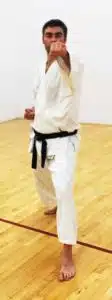
Too wide front stance was already shown earlier on pic 4c in part 1 of this article. In context of legs’ mutual empowerment such a stance is an excellent example of one that lacks energetic coherence. Front leg powerline is not aligned with the rest of the body causing weakened interaction between both legs regardless whether the position of back leg is correct or incorrect. Not only use of the ground is limited here but the entire circuit will leak the energy as well and body system will not recharge automatically after completing the sequence due to reaction force leaving the circuit. Such stance sufficiently limits the full synchronicity between mind, breathing and technique.
Another, (and perhaps most visible) practical example of the interaction between legs is block/counter attack when shuto uke (knife hand block) is used in kokutsu dachi (back stance) and followed by reverse punch in zenkutsu dachi. The interactive action of legs that happens here is the foundation of the sequence both technically and strategically.
Similar to previous example of kizami zuki –gyaku zuki, the effectiveness of counter-punch depends strongly on the volume of the energy transferred between the front and back leg (and engaging body center forward while switching the stance, of course).
The combined energies of both blocking action and opponent’s attacking technique must be retrieved by joining internal energy circuit and enforce engagement of back leg/counter action of reverse punch. Entire process has to be continuous and assisted by optimal breathing action but most of all – have support of proper stance.
Incorrect stance used in above sequence will obstruct natural energy and create strategic gap an opponent could use.
Pic 7a. Correct position of front leg helps to fully enforce the back leg in back stance.

Pic 7b. Back stance is too wide. At least part of the ground reaction will omit the energy circuit formed between both legs leading to less than optimal energy management.

Identical mechanism of legs enforcing each other is involved while changing direction.
The 180 degree turn with soto uke in Bassai Dai kata is a good example.
Pic 8a and pic 8b. Initial pressure from the back to the front leg enforces the left leg powerline and helps to increase the ground reaction/momentum of the turn. Although suspending /lifting the body while turning may help with speed it lacks the authentic increase in the momentum and power of the technique due to the absence of grounding based acceleration.
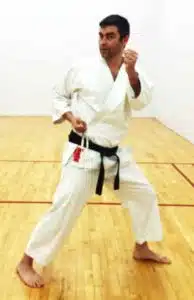
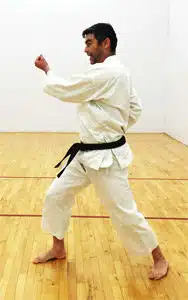
Since providing techniques with support of energy lines and allowing maximum interaction between legs are vital tasks of every stance, it’s important to make sure the position of the foot in relation to the leg remains proper at all times. This element greatly influences strength of a stance and its functioning.
The foot is the first receptor of reaction forces from the ground and the way it is aligned with the leg strongly determines the quality/volume of the upward energy transfer.
Pictures 9a, 9b and 9c show different cases of same position of the foot in relation to the leg.
Pic 9a. Foot of the front leg in left zenkutsu dachi- look from above. Position of the foot identical to natural (ground zero) stance. The foot, knee and hip joint stay on the same upward line.

Pic 9b. Front foot’s position in sanchin-dachi.
The inward twist follows the medial rotation of entire leg.

Pic 9b. Front foot’s position in sanchin-dachi.
The inward twist follows the medial rotation of entire leg.

Apart from the front stance the good example of the outward twist of entire leg that requires the change in foot’s position is shiho dachi (sumo stance).
In this stance entire body positions itself to counter and neutralize the push from the front. Since efficient use of the floor is crucial both feet must maintain correct position. Stance with feet not following lateral twist of the legs will be very weak (pic 10a and pic 10b).
Pic 10a. Correct position of the foot adjusted to lateral twist of the leg applied in proper shiko dachi. Strong support against the push.
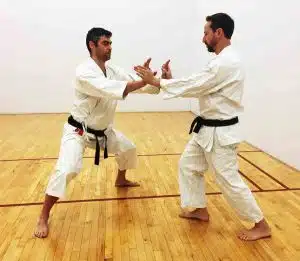
Pic 10b. Incorrect shiko dachi with both feet parallel to each other (feet position identical to kiba dachi – horse stance, here with lateral rotation of the knees at the same time). Such stance prevents the legs from rooting properly causing the energy circuit to lack enforcement. Even slight push from the front results in the structure’s collapse.

CLICK HERE for part 1 of General Concepts Of Shotokan Stances Dachi




